
Most small labs do quality control properly in spirit and badly in practice. The controls get run. The values get written down. And then, at the end of the month — or worse, the night before an assessment — someone opens a spreadsheet and tries to reconstruct whether the analyser was actually in control for the last four weeks. It usually was. But "usually" is not what a UKAS assessor is asking about, and a spreadsheet rebuilt after the fact is not what they want to see.
This guide is about closing that gap: what the Westgard rules actually do, why running them live matters more than running them thoroughly, and what a defensible QC record looks like when an assessor asks to see it.
Why month-end QC quietly fails
Retrospective QC has three problems, and they compound.
The first is timing. If a control breached a rule on the 6th, you want to know on the 6th — before you've reported a fortnight of patient results on an analyser that was drifting. Catching it at month-end means the question is no longer "do we repeat this run?" but "do we recall these results?" That is a much worse conversation.
The second is subtlety. Run your Levey-Jennings chart by eye at month-end and you will reliably catch the dramatic single outlier. You will reliably miss the slow, quiet bias — the kind where every point is within range but ten of them in a row sit just above the mean. That pattern is a real systematic error, and it is exactly the kind of thing the multi-rule Westgard system was designed to catch and the human eye is designed to overlook.
The third is evidence. Even when your retrospective review is correct, you have produced a spreadsheet, not a record. There is no timestamped trail showing when a rejection was spotted, who investigated it, and what they decided. To an assessor working through ISO 15189, that absence is the finding — not the QC itself, but the inability to prove the QC was acted on at the time.
What the Westgard rules actually do
The Westgard system isn't one rule; it's a small set of rules used together, so that you reject a run when something is genuinely wrong and don't reject it for ordinary statistical noise. Each rule is tuned to catch a different kind of error. Here's the core set in plain terms.
- 1-2s (the warning). One control result falls outside the mean ±2 standard deviations. On its own this is not a reason to reject — roughly 1 in 20 good results will land here by chance. It's a trigger to look at the other rules. Treating 1-2s as an automatic rejection is the classic way to drown a good lab in false alarms.
- 1-3s. One control falls outside the mean ±3SD. This one is a rejection. A single result that far out is very unlikely to be chance; it usually signals a random error — a bubble, a bad aliquot, a one-off analyser hiccup.
- 2-2s. Two consecutive control results fall outside the same ±2SD limit (both high, or both low). This signals a systematic error — a shift in calibration, a reagent lot change, a drift that's now consistent rather than random.
- R-4s. Within a run, the spread between two controls exceeds 4SD — one lands beyond +2SD and the other beyond −2SD. The controls are diverging in opposite directions, which points to random error / loss of precision.
- 4-1s. Four consecutive results fall outside the same ±1SD limit. None of them is dramatic on its own, but four in a row on the same side is a clear systematic drift.
- 10x. Ten consecutive results fall on the same side of the mean. Every point can be "in range" and you'd still have a problem: a persistent bias the eye glides straight past.
The art is in combining them. 1-3s and R-4s mostly catch random error; 2-2s, 4-1s and 10x mostly catch systematic error. Run as a multi-rule system, they give you sensitivity to real problems without rejecting every run that happens to wobble.
The Levey-Jennings chart: necessary, not sufficient
The Levey-Jennings chart — control values plotted over time against the mean and the SD bands — is the right picture to be looking at. It's how you see a drift forming. But a chart is a visualisation, not a decision system. Two labs can look at the same chart and disagree about whether to reject. The Westgard rules exist precisely to remove that ambiguity: they turn "does this look off to you?" into a defined, repeatable decision. The chart shows you the shape; the rules make the call.
Why "live" beats "thorough"
Here's the shift that matters most for a small lab: it is better to run a modest QC scheme live than an exhaustive one retrospectively.
Live QC means the rules are evaluated the moment a control result is entered, against that assay's own mean and SD, using the specific rules you've chosen for it. A rejection fires immediately — before the run is released, not after the results are gone. The person at the bench gets the signal while they can still act on it cheaply: repeat the control, check the reagent, recalibrate. The error is contained at the point of origin instead of being discovered downstream.
And live QC produces the thing retrospective QC can't: a record made at the time. When the rule fires, the event exists — dated, attributed, and ready to be investigated then and there.
What a defensible QC record looks like
ISO 15189 doesn't just want you to do QC; it wants you to be able to show you did it and acted on it. In practice, an assessor reviewing your IT and process controls is looking for a chain like this:
- The control result, with its assay, level, lot and timestamp.
- The rule that was evaluated and whether it passed or failed.
- For a failure: an investigation record — who looked at it, what they found, what they did (repeat, recalibrate, accept with justification), and when.
- An audit trail showing none of this was edited after the fact.
If you can produce that chain on demand, the QC conversation in an assessment is short. If you're rebuilding it from a spreadsheet and your memory, it isn't.
Try it yourself: our free Westgard rules calculator evaluates the full multi-rule set against your own QC values and plots a Levey-Jennings chart — no sign-up, runs in your browser.
How FreshLIMS handles this
FreshLIMS was built so that this chain exists by default rather than as month-end homework.
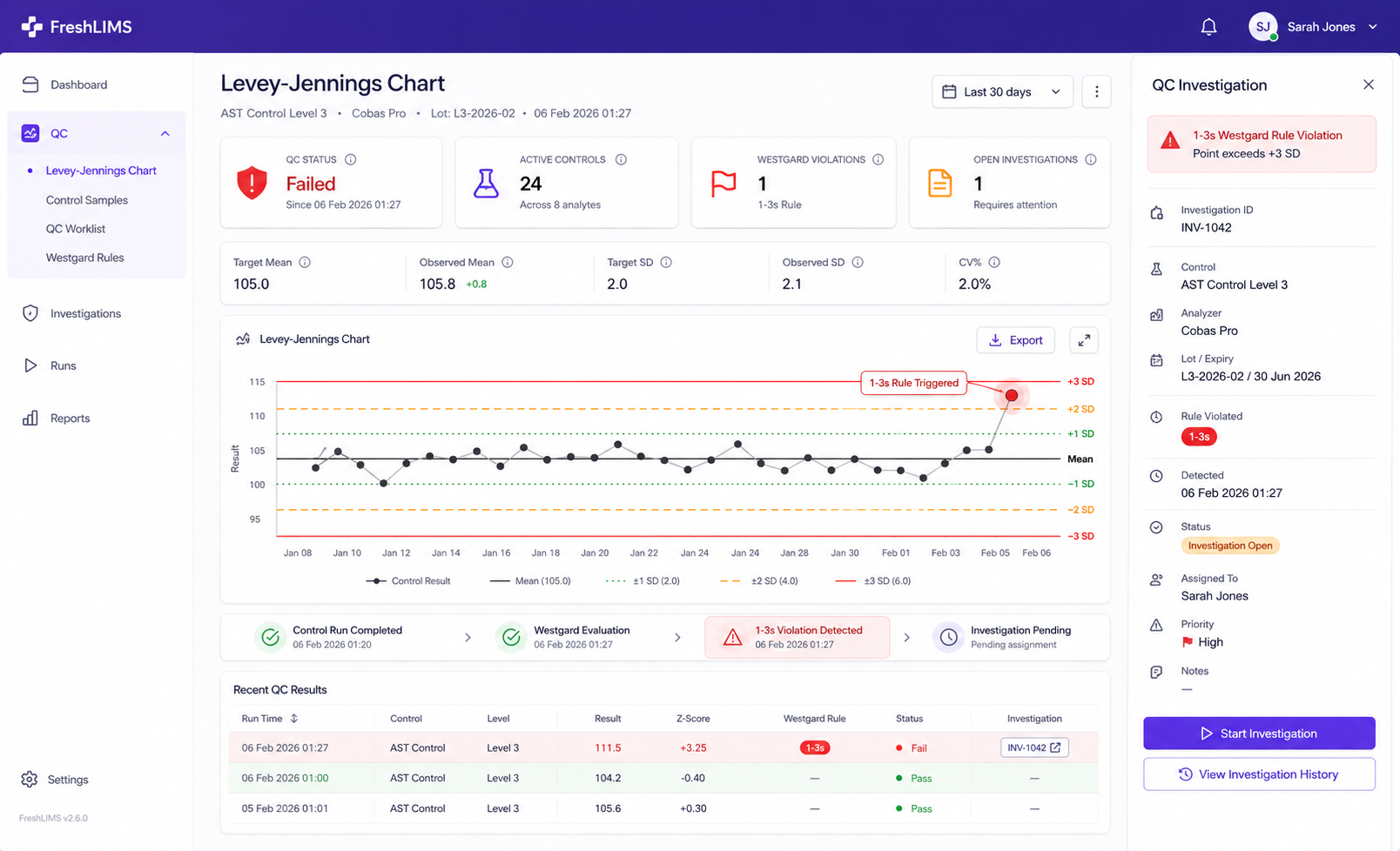
The QC engine evaluates the full Westgard rule set — 1-3s, 2-2s, R-4s, 4-1s and 10x, with the 1-2s warning — live, as control results are entered, against per-assay reference ranges and QC lots. Levey-Jennings charts give you the visual; the rules make the call. Which rules apply is configurable per assay through the QC rule settings, so you're not forced into a one-size-fits-all scheme that buries you in false rejections.
When a rule is violated, FreshLIMS flags the violation and lets you open a QC investigation in one click — so the record of what happened next is created at the moment it happened, attributed and timestamped, on an append-only audit trail. Per-assay reference ranges and panic-value thresholds sit alongside the QC engine, so a critical result is caught before a report goes out. The result is that your QC manager walks into an assessment with the evidence already assembled, rather than reconstructed.
To be clear about what that does and doesn't mean: FreshLIMS is the software, not the accreditation. UKAS awards accreditation to the laboratory, against its own scope. What FreshLIMS provides is the platform and the QC evidence that supports your submission — and, notably, an independent diagnostic laboratory in London passed a UKAS ISO 15189 assessment and a CQC inspection running it.
The takeaway
You don't need a bigger QC scheme. You need a live one, with the Westgard rules doing the deciding and a record that writes itself as you go. Get that right and month-end stops being a reconstruction exercise — and an assessment stops being something to dread.
Related: ISO 15189 readiness — what a UKAS assessor actually looks for.