
Accreditation is not won in the week before the assessment. It's won — or lost — in whether the work you do every day leaves a record an assessor can follow. ISO 15189 doesn't ask whether you can run a good lab; it asks whether you can show that you did, on any sample, on any day, without rebuilding the evidence from memory.
This guide is the practical version of that idea: what a UKAS assessor actually looks at during an ISO 15189 assessment, where labs reliably lose marks, and a checklist you can work through before the visit. It's written for the independent and specialist labs we work with — the ones without a dozen-strong quality department to carry the paperwork.
ISO 15189:2022 in one paragraph
ISO 15189 is the international standard for quality and competence in medical laboratories. In the UK, UKAS is the body that assesses a lab against it and grants accreditation. The 2022 revision reorganised the standard around risk and the patient: it pulled point-of-care testing into the main standard, leaned harder on risk management, and tightened the expectations around impartiality and the competence of personnel. The throughline hasn't changed, though — every requirement ultimately comes back to traceability and evidence. If a result left your lab, an assessor wants to follow it back to the sample, the method, the calibration, the QC that was in control at the time, and the person who authorised it.
What the assessor actually does on the day
An assessment is less an interrogation than a trace. A common pattern: the assessor picks a recent patient result more or less at random and asks you to walk it backwards. Where did the sample come from, and how was it identified at receipt? What method ran it, and was that method validated or verified for your use? Was the analyser calibrated, and was QC in control around the time of that run? Who reviewed and authorised the result, and were they competent and authorised to do so? Has anything in that chain been edited since — and if so, by whom, when, and why?
If you can produce that chain quickly and it holds together, the conversation is short and the assessor moves on. If you're opening three systems and a spreadsheet and saying "it'll be here somewhere," the finding writes itself — and it's rarely about the science. It's about the traceability.
The pre-assessment checklist
Work through these before the visit. None of it is exotic; the labs that struggle aren't missing the concepts, they're missing the evidence on demand.
Documents & document control
- Current, version-controlled SOPs for every examination in your scope — and a way to prove staff are working to the current version, not last year's printout.
- A quality manual and policies that match what the lab actually does (assessors notice when the document describes a process nobody follows).
- A controlled record of document review dates and approvals.
People & competence
- Training and competency records for each member of staff, mapped to the procedures they're authorised to perform and to sign out.
- Evidence of ongoing competence assessment, not just initial sign-off.
- A defined authorisation matrix: who can authorise which results.
Equipment, methods & QC
- Method validation or verification records for each assay in scope.
- Calibration and maintenance records for analysers, with traceability to reference materials.
- An internal QC scheme that's actually run — controls, rules, and a contemporaneous record of evaluation (see our guide to live Westgard QC).
- EQA / proficiency-testing participation and a record of how poor performance was investigated.
- Reference ranges and clinical decision limits defined and reviewed per assay.
Results, reporting & the patient
- A clear path from order to authorised report, with critical / panic-value handling defined and evidenced.
- Traceability from each reported result back through the analytical run to the sample and the request.
- Turnaround-time monitoring against your stated commitments.
Nonconformities, risk & data integrity
- A nonconformity / CAPA log with real entries, root-cause analysis, and evidence the actions closed the gap.
- Risk assessments for the processes that matter — the 2022 standard expects this explicitly.
- An audit trail showing records weren't altered after the fact — attributable, timestamped, and tamper-evident.
- A data-backup and continuity arrangement you can actually demonstrate, not just assert.
Where labs actually lose marks
Across assessments, the findings cluster in the same few places — and they're almost never "your science is wrong."
- Retrospective QC. QC that was reconstructed at month-end rather than evaluated and acted on at the time. There's no timestamped record of when a breach was caught and what was done.
- Broken traceability. The result is fine, but linking it back to the specific calibration and QC of that run means stitching together exports by hand.
- Document control drift. Staff working to an out-of-date SOP, or a procedure that describes a workflow the lab quietly stopped using.
- Audit-trail gaps. Records that can be edited without leaving a trace — the single fastest way to undermine confidence in everything else.
- CAPA on paper only. A nonconformity log full of entries that were opened and never demonstrably closed.
The IT and records angle — where the right system earns its keep
You can pass ISO 15189 with paper and discipline; plenty of labs have. But most of the findings above are evidence-and-traceability problems, and that is exactly what a laboratory information system is supposed to remove. A LIMS that helps rather than hinders an assessment should give you, by default:
- An append-only audit trail over every record-changing action — so "has this been edited?" has a definitive answer.
- QC evaluated live, with the rule result and any investigation captured at the time, against per-assay reference ranges and control lots.
- Traceability built into the data model, so a result already links to its sample, run and QC without manual stitching.
- Role-based access and authorisation enforced by the system, matching your competency matrix.
- Your data, exportable — you can hand the assessor (or your successor system) a complete record without begging the vendor.
How FreshLIMS supports an ISO 15189 submission
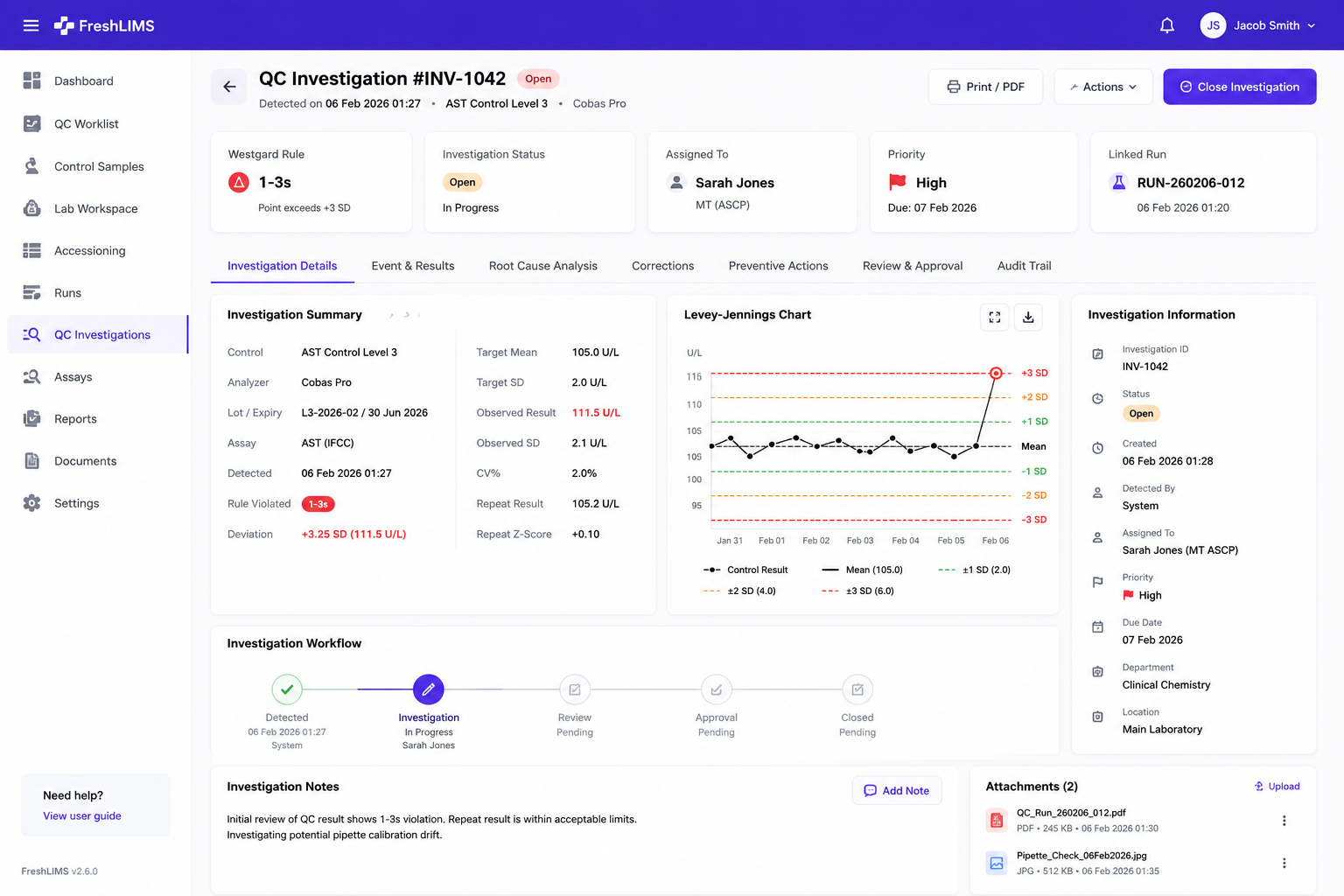
FreshLIMS was built around the evidence an assessment actually turns on. The QC engine evaluates the Westgard rule set live as controls are entered and turns each violation into a one-click, timestamped investigation. Every record-modifying action lands on an append-only audit trail; access is role-based and enforced server-side; results trace back to sample, run and QC by design; and the lab can export its full dataset at any time. There's also a supplier validation pack — system overview, an ALCOA+ data-integrity statement, GAMP 5 categorisation and SOP templates — written to drop straight into your quality file.
To be precise about what that means: FreshLIMS is the software, not the accreditation. UKAS accredits the laboratory, against its own scope and practice — a vendor cannot be "UKAS accredited" on your behalf. What FreshLIMS provides is the platform and the evidence that supports your submission. The strongest thing we can honestly say is this: an independent diagnostic laboratory in London passed a UKAS ISO 15189 assessment and a CQC inspection while running FreshLIMS.
The takeaway
Readiness isn't a binder you assemble the week before. It's whether your everyday work leaves a record an assessor can follow without your help. Get the traceability and the contemporaneous evidence right, and the assessment stops being something to survive and becomes something you can simply show.