Sample lifecycle
Accessioning with barcode verification. Aliquots, batches, retests, holds, rejections — every state change captured with who, when, why. Record where each tube is stored, down to rack, box and position.

From the moment a sample is checked in to the moment a signed PDF lands with the clinic, FreshLIMS handles the workflow, the QC, the alerts and the paperwork. Built so you spend less time on the system and more time on the science.
Accessioning with barcode verification. Aliquots, batches, retests, holds, rejections — every state change captured with who, when, why. Record where each tube is stored, down to rack, box and position.
Connect your analysers so results flow in without re-keying. Build a run, lay samples and QC across the plate, and route the whole worksheet through review.
Full Westgard rule set (1-3s, 2-2s, R-4s, 4-1s, 10x and 1-2s warning) on every QC point, with a QC schedule set per assay. Open an investigation straight from a rejection — or raise one by hand — and see which patient results since the last good run need checking.
Per-assay ranges by demographic, panic-value alerts before the report is signed off, and a flag when a result has moved sharply from the patient's last one. A report with a critical result can't be released until someone logs that it was phoned through.
Role-based review, with the option to require a second person to sign off results. Each approval records the user, time and credential — printed on the PDF.
Every revision is preserved and earlier versions stay accessible, marked as superseded. An amended report is labelled as amended and records who changed it and why.
Clinics submit orders directly into your queue. Sample status updates them live. PDF reports delivered automatically.
Pull billable orders into draft invoices, generate PDF invoices, record payments. The clinic sees the same invoice in their portal.
Set rules that order follow-on tests automatically when a result meets your criteria — the cascade fires without anyone re-keying the order.
Route tests you don't run in-house to a reference lab, pack and dispatch them, and record the results on the same order and patient record — with the reference lab named on the report.
Append-only audit log of every meaningful action. Visitor logs, sign-in attempts, configuration changes — all captured. An outbound message log shows every email and webhook the lab sent, and why any failed.
Exchange orders and results with other systems over HL7, and let other software plug in with API keys and webhooks.
Import antibiotic breakpoint tables and procedure templates instead of typing them in by hand.
Median and 90th-percentile turnaround for each test, with the orders still outstanding or overdue listed so nothing sits unnoticed.
Keep calibration, maintenance and EQA records for each analyser. Patient results are held automatically while an analyser is out of service or overdue for calibration or maintenance.
Version, approve, review and retire SOPs in the system, so staff work to the current version and you can show the assessor its history.
Receive lots into quarantine, accept them with lot-to-lot comparisons against your limits, and track opening, in-use expiry and disposal. Calibrations are flagged if they used an unaccepted or expired lot.
Authenticator-app MFA that admins can require, an idle sign-out time set per lab, forced password changes and one-time passwords that expire.
Barcode-first check-in verifies the order, shows every tube in it, and routes each specimen to the disciplines it needs — chemistry, haematology, immunology and the rest — from a single screen.
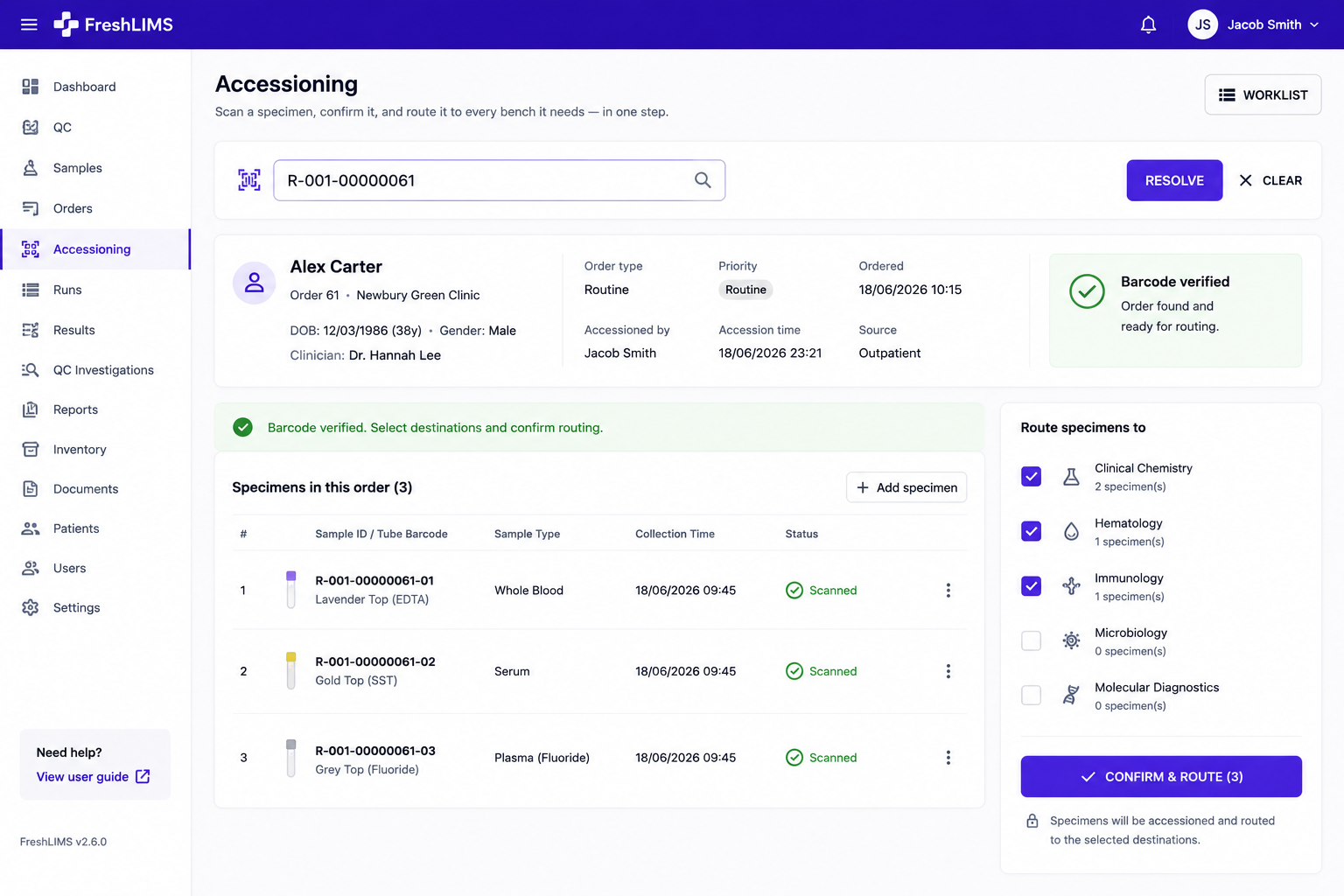
Each discipline has the QC, the catalogue and the report format it needs, all on the same patient record and the same audit trail.
Quantitative results, reference ranges by age and sex, automatic eGFR, panic values and the full Westgard QC engine.
Cultures, organism identification and isolates through to antibiotic susceptibility, with importable breakpoint tables and intrinsic-resistance rules.
PCR runs and targets with per-run QC controls and qualitative cut-offs for positive / negative interpretation.
Sequencing runs with variant detection and genotype interpretation, written up as specialist reports.
Most labs lose months trying to validate a LIMS that wasn't built with the assessor in mind. We hand you the pack.
| What's in the pack | Why it matters |
|---|---|
| Software requirements specification mapped to ISO 15189:2022 §7.6 (control of data and information management) and the clause 7 process requirements | Lets your QC manager show traceability between requirement, control, and feature. |
| IQ / OQ / PQ test scripts | Templates your team can execute and tick. No re-writing scripts from scratch. |
| Change control & release notes process | How you'll be told that v1.4 fixed a bug that affects your validated workflow. |
| Data integrity statement (ALCOA+) | Attributable, legible, contemporaneous, original, accurate. |
| Hosting / security / backup / DR white paper | SOC 2-lite description of what we run, where, encrypted how, backed up how often, restored how. |
| Cybersecurity posture | Encryption in transit + at rest, authenticator-app MFA that admins can require for every user, password policy, session timeouts, role-based access controls. |
| Data export / portability statement | Your lab's data is yours. Full export available on exit. |
Every Lab Platform plan includes the validation pack.

One of our customers — a UK clinical diagnostic lab — completed UKAS 15189 assessment and a CQC inspection running FreshLIMS as their LIMS. The validation pack covered the IT-systems clauses; their QC manager handed it to the assessor.
You get the same engine, the same pack, the same audit trail. We support the prep call when you need us.
Talk to sales